
Residental PerfectPressurePump (TM pending)
The Residential Perfect Pressure Pump Is our newest offering that reduces cost but enjoys all the algorithms of our commercial P3. It carries a 5 year warranty. It is rugged implementing a NEMA 4X, water proof drive, stainless steel pump, impeller and brass check valve.
The PerfectPressurePump is designed for residential applications. Unlike our commercial P3, it does not have an output gauge, disconnect switch, On/ off switch or pressure knob. Pressure is set on the key pad along with start/stop functions. The display shows actual and setpoint pressures.
At a $2,900 price point, why would you spend that much money when you can buy cheaper?
It’s all about value, not front end price. When you realize our products are field repairable, carry a 5 year warranty and are designed to last in commercial applications, the price becomes secondary to a product you can just set and forget. Confidence that the product will just keep running and peace of mind if you do have a question, you can call TAW and speak with the person that designed the product.
When you get tired of purchasing from a big company that long lost its passion for customer service, replaced by shareholder profits, give us a try.
You can call us direct at (407) 493.2355 to discuss your application.
All we ask is if you have a question or concern, call us first before leaving a review because we pride ourselves on happy customers.
With over 460 units sold we never have had a dissatisfied customer. That is not marketing hype, that is engineering fact.
Call us today (407) 493.2355
Includes shipping within the continental USA. The unit ships USPS ground & weighs 44 lbs.
Box dims. are 23″L X 16″H X 13″W.
Once you confirm there is no damage, please take the time to read the Installation and operation manual on this site.
Included in the box:
- Pump, complete with motor & drive, bronze check valve & pressure transducer.
The Residential PerfectPressurePump (PPP) enjoys all the advanced algorithms as our commercial P3 Pumps. These algorithms were developed over the past 47+ years and no other pump has them.
Low Flow Algorithm – Electronically determines when there is no real water demand, preventing the pump from overheating. We do this without a flow meter or suction pressure gauge. The result is no pump heating, longer lasting seals (typically 10X the competition),
Electronic Bladder Tank Algorithm – The PPP does not require a bladder tank to maintain smooth pressure demand changes. PPP differenciates between real water demand and slow leaks such as toilet valves. Instead of cycling when the pressure drops below setpoint the pump will allow the pressure to drop to a programmable minimum pressure, once reached , it will pump back up to setpoint and shut off. This prevents cycling, increases pump life and saves energy. When a true demand is sensed, the pump immediately turns on.
Predictive PID Algorithm – A typical pump response to demand changes reacts like a spring, competitors will cycle high and low prior to settling to the desired pressure. PPP determines what the speed should be before reaching setpoint providing a true squarewave response. The result is instantaneous response with little overshoot.
Anti-Cavitation Algorithm – It is impossible to burn out the pump due to demanding more than the pump can deliver. When this occurs the pump will automatically start slowing down and displaying cavitation setpoint. If the pressure continues to fall to the minimum pressure pump will fault and display “Water Problem”. This could occur if you get air in the line, lose house water or have a pipe break.
PPP will outperform the competition in longevity.
You can spend less but you can not buy better. It is this reason we give the pump a 5 year warranty.
Commercial quality components that are field serviceable sets us apart from lower cost pumps.
If a transducer, internal bladder tank, check valve, seal or even impellet fails, it’s a fast fix unlike throw away pumps.

- When mounting the pump try and make your install as easy as possible.
Determine a location near the water coming into the home and as convenient as possible to power. You will need 230V power or you can purchase an optional 110V to 220V step up transformer if you do not have 220V power. Most homes built in America have 220V available. - Mount the pump above grade by at least 2 inches if being mounted outdoors. The reason for this is to prevent water puddling at the base of the pump. Although the pump is water proof it is NOT submersible. Standing water will damage the unit and void the warranty. A quick method of mounting is to bury a cement cinder block 3/4 in the ground on its side. Then position the pump on top of the block and mark the hole pattern with a sharpie.
- Purchase a tapcon kit 1.5″ X 1/4″ is sufficient, the kit comes with a mason drill.
- Remove the pump temporarily.
- Pre-drill the holes you previously marked.
- Re-place the pump on the block aligning the holes.
- Screw down the tap-cons until snug.
Depending on local codes, you may have PVC, CPVC, copper, stainless or galvanized pipe.
Please follow local codes before installing the pump with proper material.
At this point, it may be a good idea to hire a plumber since this is an advanced DIYer project. But if you feel qualified and are up to the challenge, let’s continue.
- Turn off the main water supply. If you are on city water, it’s typically on your property close to the street.
- Once you are certain the water is turned off by opening a hose bib and allowing any retaining water to bleed off, cut into the line at a place convenient to the pumps locale.
- This is where your location will change the type of pipe you will use.
- We suggest always installing a bypass valve arrangement. It will require 3 valves and 2 quick disconnect fittings.
- Thread the 1 1/4″ pipe or combination of reducer and your pipe to the inlet side of the pump, also called the suction side.
- Thread the 1″ NPT outlet side of the pump using appropriate materials and reducers if needed to match your existing piping.
- The bypass valve arrangement is shown in the diagram to the right.
- Once the plumbing is finished, apply water by turning on the house water supply and slowly turning on the input and output valves. Turn OFF the bypass valve and check for leaks. Fix any leaks.
- Check the water inlet pressure gauge that you mounted to your existing pipes.
- Check output pressure gauge supplied on the pump.
- The pump is now ready for power.
- If you are not qualified to wire this product, please contact a certified electrician. Please adhere to local codes when wiring this product.
- A 2 pole, 15 amp GFCI breaker is required to protect personnel and product.
- Wire the pump with no less than 14 gauge two wire with a ground of equal gauge.
- Use mechanical reliefs and mechanical shielded cable.
- Open up the cover of the drive and feed the cable through the strain relief hole on the right looking at the back of the unit.
- Connections inside the drive are made by stripping back THNN wire by at lease 1/2″ and pushing the wire into the holes as shown in the picture to the right. Make certain the ground is connected. Connect to L1 & L2 as shown in the right picture. Ground is connected under screw attached to the heatsink.
- Tug on the wires to insure good connection and once you are confident they are connected replace the cover BEFORE applying power.

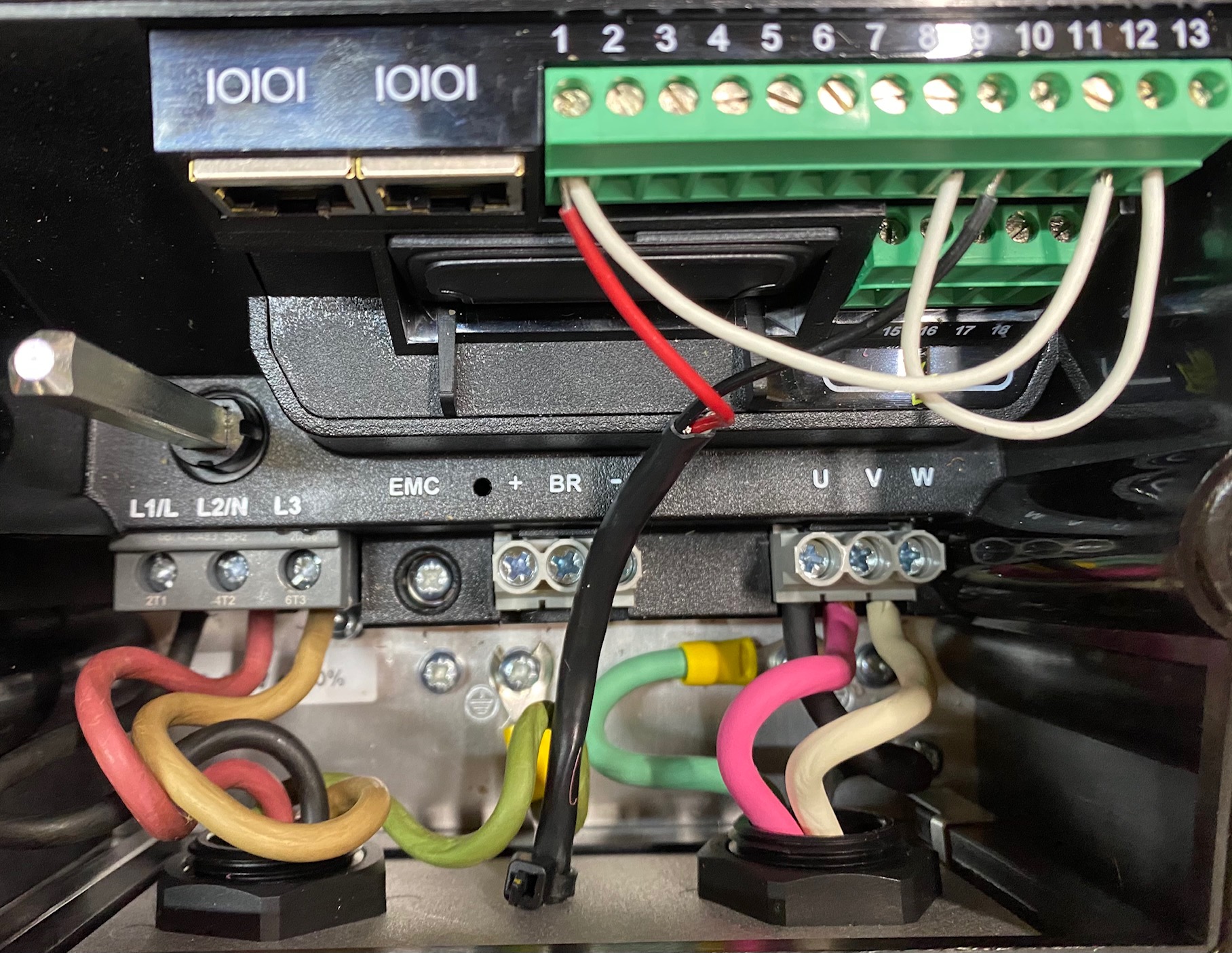
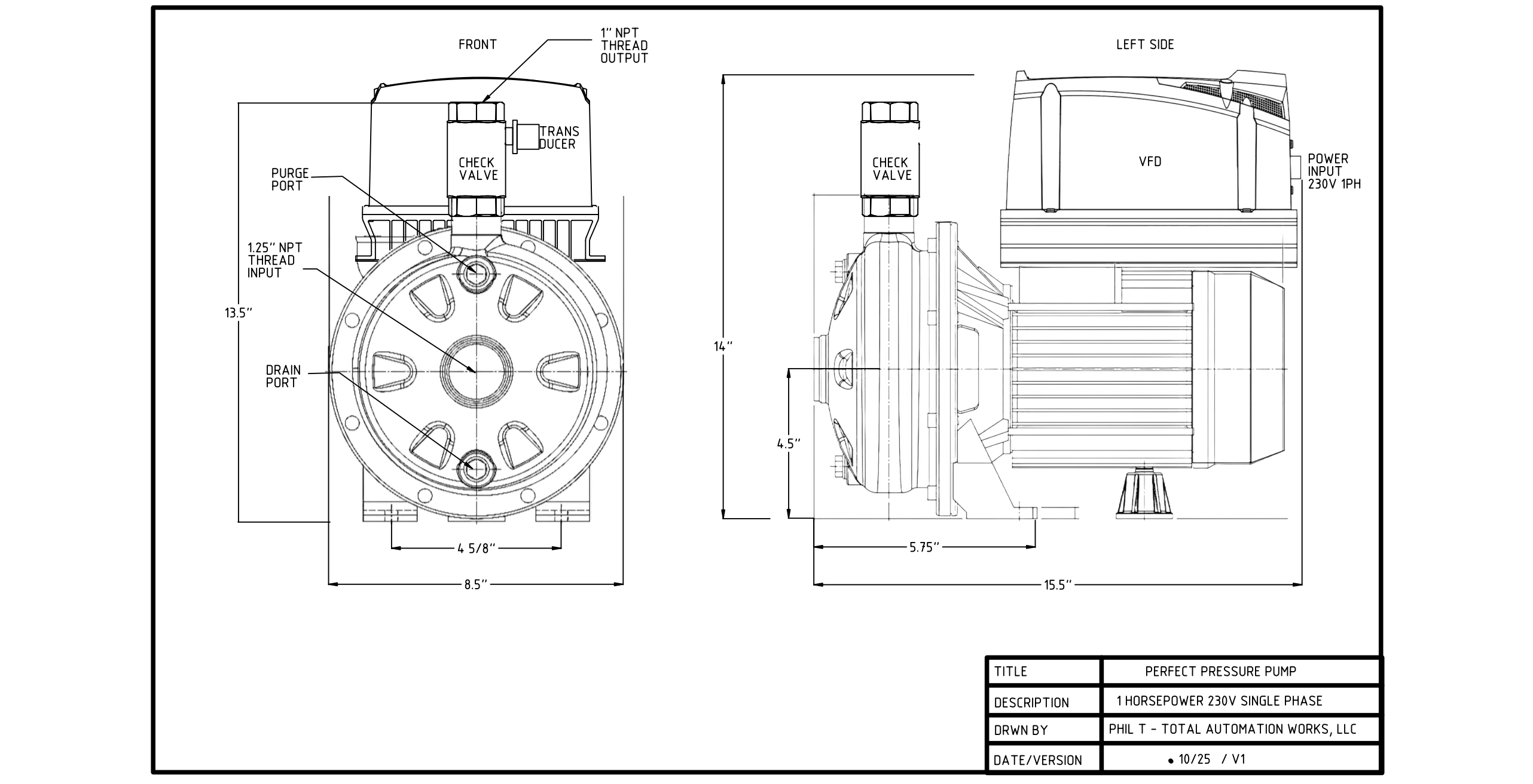

- With the cover on the unit, apply power to the unit. The unit is rated 230v single phase, 15 amp, 2 pole GFI breaker should be used.
- Display will light and show actual pressure & setpoint pressure alternating every 2 seconds.
House pressure should not be set above 75 PSI and the pump limits this setting to 80. We advise keeping the pressure between 60- 65PSI . Make note of the incoming pressure. With the pump off and turning on a faucet the display will show you the normal house pressure without the pump. The pump can not supply more than 40PSI above your incoming pressure, attempting to do this will make the pump cavitate and automatically over-ride the setpoint. The pump will show cavitation pressure if you are attempting to overload the pump. It will slow the pump down until the pressure can be maintained. Air in the line will be indicated by “water problem” displayed. If this occurs, bleed the pump from air by loosening the 12 o’clock position hex nut on the pump 1/2 turn CCW. Water and air will escape so have a towel handy. Once all the air bubbles stop and only water is coming out the pump is ready to run. To prevent this damage, the pump incorporates an anti-cavitation algorithm. If the pump is running at full speed but can not maintain the pressure set point, it will automatically lower the pressure setpoint to the point it can keep up. determine your maximum flow by turning on several fixtures and a shower & observe the incoming pressure, the setpoint should not be set higher than 40PSI above this to prevent the cavitation algorithm from ever operating. For example, if you turn on two showers and a faucet and your supply pressure is 10 PSI, the pump setpoint pressure should be set to 50PSI, 40 above the 10 PSI supply pressure.
The pump can not make up for not enough water supply from the city or your well so keep this in mind when setting your pressure.
The electronic bladder tank setting is on P1-15. Pushing the center square button for 5 seconds and then push the up arrow key until you get to P1-15.
Once on P1-15 push the center square button again to set the min pressure. This should be set to 5 PSI above the inlet pressure to the house and is default 40 PSI from the factory. Once this pressure is set push the center square button one last time to save the setting.
- Turn on a faucet in the home, the pump should turn on to maintain the setpoint.
- Flush a toilet, again the pump will turn on and turn off after a time delay after the toilet finishes filling.
- Turn on a shower and a toilet and the pressure will maintain the setpoint assuming there is enough water supplied to the home.
- If the pump can not keep up or there is air in the line “Water problem” will display.
- If the pressure does not maintain, look at the inlet pressure gauge, the pump can only supply a boost pressure of 40 PSI max.
- So if the suction pressure drops to 20 PSI, a maximum of 60 PSI is all you will get regardless of the setpoint being set higher. Picture two shows this in real time.
- Troubleshooting and normal operations are covered fully in the manual.
- ENJOY YOUR PERFECT PRESSURE!
